How to Reset Your Goals When Life Doesn't Go to Plan
How to Get Back on Track With Your Goals
When Life Doesn’t Go to Plan
At the beginning of last year, I genuinely thought I was going to have so much time.
After an incredibly full season, I had finally dialled things back. I had goals I wanted to hit, habits I wanted to rebuild and things in my life I was determined to change.
In my head, this was going to be my year of growth, achievement and momentum.
Except it wasn’t.
By September, I wasn’t anywhere close to where I’d planned to be.
I’d had more “day ones” than I cared to count. I’d procrastinated. I’d struggled to rebuild habits that once felt easy. And I spent far too much time frustrated with myself for what I should have accomplished by then.
My instinct was to assume I needed more discipline.
A better routine.
More motivation.
A new plan.
But eventually I realised something:
The problem wasn’t necessarily that I had failed at my goals. The problem was that I’d created goals for a life I wasn’t actually living.
And that changed the way I thought about Christian goal setting.
If your own goals have wobbled and you’re wondering how to get back on track with your goals, here’s what I wish I’d understood sooner.
1. I hadn’t accounted for the season I was in
The year before had been full-on.
And when I say full-on, I mean working close to full-time hours around having a child at home, school pick-ups, family life, ministry and a husband who travelled regularly.
I knew I was tired.
What I hadn’t realised was how much recovery I actually needed.
I had created my goals based on the capacity I wanted to have rather than the capacity I actually had.
So when I couldn’t make myself do everything I’d planned, I interpreted it as a motivation problem.
It wasn’t.
Realistic goal setting starts with the capacity you actually have, not the one you wish you had.
Sometimes the most useful thing you can do with a goal is ask whether it still fits the season God has you in.
A good goal in the wrong season can still be the wrong goal.
2. I tried to change everything at once
I didn’t choose one or two areas to work on.
I tried to fix all of them.
Exercise. Food. Spiritual habits. Productivity. Work. Home. Personal growth.
Before long, I had what felt like 15 imaginary boxes I was supposed to tick every day.
And when I couldn’t tick all 15?
I didn’t want to tick any.
Maybe you know that cycle too.
We create an ideal version of ourselves, build a plan around her, fail to maintain it and then decide we’re inconsistent.
Even good Christian goals, like more prayer, more rest and more consistency, can turn into pressure when we try to chase them all at once.
But sustainable growth rarely happens through a complete life overhaul.
It happens through small actions repeated long enough to become part of who we are.
3. I was measuring progress by the wrong things
I was looking at the goals I hadn’t hit and missing what God had actually been doing.
Maybe that season wasn’t meant to produce impressive results.
Maybe I needed to learn how to rest.
Maybe I needed to recognise some unhealthy patterns.
Maybe I needed to stop measuring a good life entirely by how productive I’d been.
That doesn’t mean goals don’t matter.
I love goals. I love plans. I love taking an idea and figuring out how to make it happen.
But I’ve learned that alignment has to come before achievement. That’s the heart of Christian goal setting.
There’s no point becoming incredibly efficient at building a life God isn’t actually asking you to build.
So how do you get back on track with your goals?
Don’t automatically abandon them.
But don’t blindly push harder either.
Reset them.
Take a piece of paper and ask yourself:
What has changed?
Is my life, capacity or season different from when I set this goal?
What still matters?
Which goals genuinely matter to me, and which ones came from pressure, comparison or an imaginary list of things I think I should be doing?
What needs to be released?
What can I intentionally stop carrying for this season?
What is my priority now?
If I couldn’t change everything, what one thing would make the biggest difference?
What is the next realistic step?
Not the whole plan. Not the perfect morning routine. What can I actually do next?
And finally:
God, what are You asking of me in this season?
Because sometimes resetting a goal isn’t quitting.
It’s wisdom.
You don’t have to keep starting over
I’ve stopped seeing every disrupted plan as another failed “day one.”
Life changes.
Capacity changes.
Priorities change.
We get tired. Kids get sick. Work gets busy. Unexpected things happen. God redirects us.
A plan that doesn’t allow for real life isn’t much of a plan. That’s why realistic goal setting always leaves room for the unexpected.
What we need are rhythms we can return to.
That’s become a huge part of how I approach my weeks now: pause, get everything out of my head, decide what actually matters, make a realistic plan and leave room for God to redirect it.
Grace doesn’t mean giving up on growth.
It means we stop using achievement as the measure of our worth and start pursuing growth from a healthier place. Healthy Christian goals hold plans with open hands.
So if your goals have gone completely off track, don’t write yourself off. Getting back on track with your goals doesn’t mean starting over. It means starting from where you actually are.
Pause.
Look at the season you’re actually in.
Release what doesn’t belong there anymore.
Choose what matters now.
Then take the next faithful step.
You don’t need to have the whole year figured out.
You just need enough clarity for what comes next.
Need somewhere to start?
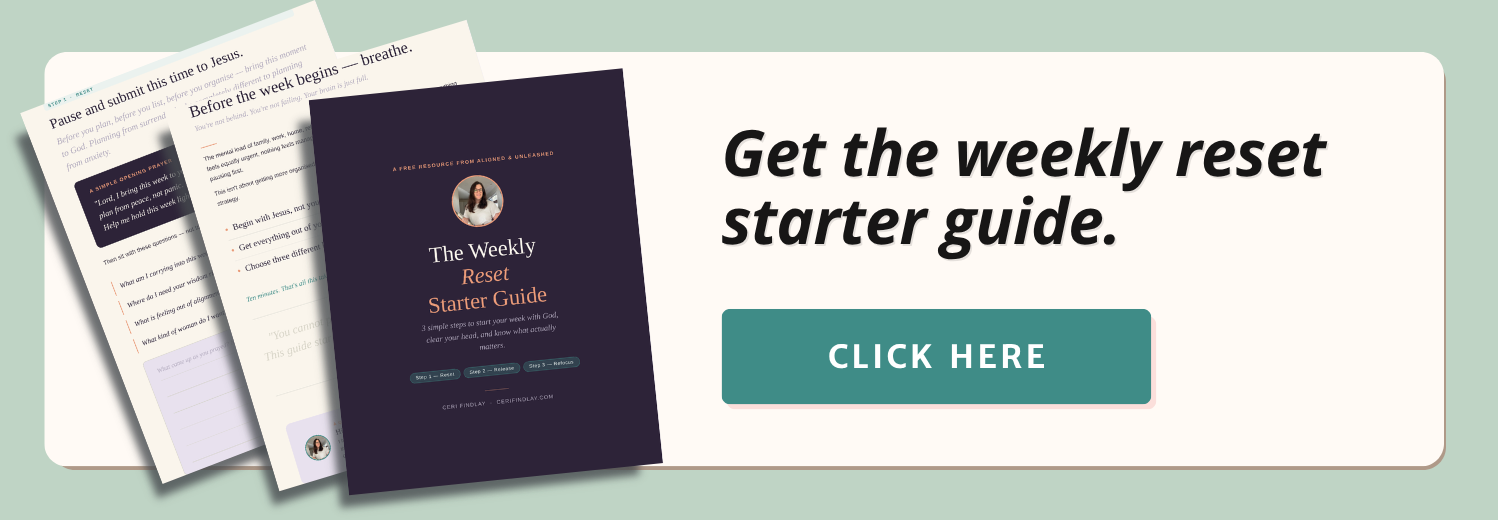
If everything currently feels important and you’re carrying far too much in your head, my free Reset Guide will walk you through a simple faith-led reset to help you clear the mental clutter, identify what matters and get back on track with your goals with more clarity.